EPA Releases Technical Guidance for Implementing EISA Section 438

9 12 2009

Just in case you missed it last week among all of the other pressing news stories, the EPA released a report outlining technical guidelines for implementing the stormwater runoff requirements for federal projects under Section 438 of the Energy and Independence and Security Act (EISA). In effort to afford designers maximum flexibility, the guidance provided is performance-based. The Section 438 of the EISA established the following requirements:

“Storm water runoff requirements for federal development projects. The sponsor of any development or redevelopment project involving a Federal facility with a footprint that exceeds 5,000 square feet shall use site planning, design, construction, and maintenance strategies for the property to maintain or restore, to the maximum extent technically feasible, the predevelopment hydrology of the property with regard to the temperature, rate, volume, and duration of flow.”

On October 5th, the White House issued a Presidential Executive Order addressing this requirement. The Executive Order titled “Federal Leadership in Environmental, Energy, and Economic Performance.” It required the EPA in coordination with other agencies to develop guidelines for implementing Section 438 of the EISA within 60 days. The current publication meets these guidelines.

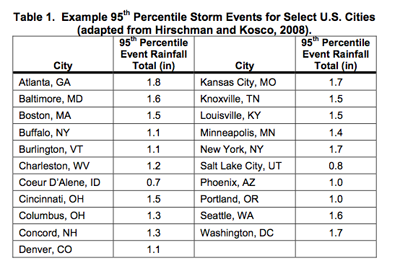
The guidelines establish two options for meeting Section 438. The first option is to retain 100% of a rainfall event on site that is less than or equal to a 95th percentile. A 95th percentile rainfall event is an event with a volume over a 24-hr period that is equal to or less than the volume of 95% of all rain events for a period of record (i.e. 20 to 30 years). The table from the report provided below shows the size of the 95th percentile events for various cities across the Country. The events range between 0.7 to 1.8 inches of rainfall. These events commonly known as a “first flush” event were identified because they often contain the highest level of pollutants. Option 2 allows designers to conduct their own hydrological analysis and determine the site specific pre-development hydrological conditions. This options states that “temperature of runoff should not exceed the pre-development rates and the predevelopment hydrology should be replicated.”

For both of these options, the guidelines encourage the use of green infrastructure stategies. The guidelines recognize that “runoff event frequency, volume and rate can be diminished or eliminated through the use of green infrastructure (GI)/Low Impact Design (LID) designs and practices, which infiltrate, evapotranspire and capture and use stormwater”. The guidelines provide a number of studies that illustrate how green infrastructure can meet the established criteria. It is exciting to see the continued momentum green infrastructure is experiencing. If your considering working on federal projects, you will need to take a serious look at green infrastructure as an integral part of your site strategy.


Kansas City Stormwater Overflow Control Plan

4 12 2009

Source: Kansas City, Missouri Overflow Control Plan Overview Document

This year Kansas City embarked on a massive $2.3 billion stormwater overflow control plan to address sewer overflows throughout the city. Its inclusion of a major $28 million green infrastructure pilot project has gained a lot of attention. The project has been recognized as the largest green infrastructure project in the United States. The Marlborough Neighborhood Pilot Project, as it is called, is located in the Middle Blue River Basin, one of the four major watersheds addressed by the plan. The entire pilot project encompasses nearly 100 acres of primarily residential neighborhoods. This program is anticipated to be expanded over a larger 744 acre area that will eventually include over 25 acres of mixed green infrastructure strategies (i.e. rain gardens, bioswales, permeable pavement, and green roofs) that have the capacity to sequester 3.5 million gallons of water. The green infrastructure strategies employed are designed to replace two underground tanks of similar capacity. In total the pilot project and its expansion are budgeted to cost $68 million.

Video of compiled images from Mark O’Hara’s Greenbuild Presentation about the Kansas City Plan. The video shows various Green Infrastructure Strategies recommended in the plan. Video compiled by Hawkins Partners Images provided by BNIM (Click here to see it if  video is not present)

In addition to the Marlborough Neighborhood Pilot Project, the plan also recommends the enhancement of the area’s highly acclaimed 10,000 Rain Garden Program. Over the past two years, the initiative is reported to have installed several hundred rain gardens, bioswales, and rain barrels. The purpose of the expansion it to develop an incentive program to accelerate the program’s progress and complement the public investments being made.

Wet retention basin projects have been identified as an appropriate strategy for treating stormwater downstream from six separated sewer system (SSS). The plan acknowledges that green infrastructure is beneficial and should be included where it is practical. The plan states:

“Every decision should be viewed as an opportunity to incorporate a green-solutions approach. The City has adopted an “every drop counts” philosophy, meaning it is important to reduce stormwater entering the system wherever practicable. This will be accomplished through changing the way the community develops and redevelops its sewer and stormwater infrastructure, educating citizens regarding steps they can take to reduce the amount of stormwater entering the sewer system, enabling citizens to take those steps, incorporating green infrastructure in the design of public infrastructure, and making targeted public investments in green infrastructure projects early in the Plan implementation.”

Areas identified that should be considered for green infrastructure projects include those meeting the following criteria:

  • Areas for which no or minimal conventional structural controls are proposed.
  • Areas in which widespread implementation of green solutions by the community at large offer the greatest opportunities for reducing the size and cost of conventional structural controls included in the Plan.
  • Areas for which it would be particularly desirable to further reduce the projected overflow
    activation frequency following completion of recommended controls.
  • Areas in which sewer separation is proposed but where no Water Services Department (WSD) investment in treating the separate stormwater runoff has been included in the Plan.
  • The plan’s ambitious Marlborough Neighborhood Pilot Project is very encouraging, particularly as a stand alone project. It is very significant and the City should be commended for their efforts. However based on the $2.3 billion budget established by the plan, it is evident that green infrastructure will play a supporting role. The plan was developed during the recent significant shift in the way we address stormwater management across the country over the last few years. It is not surprise to see this. What is encouraging is the magnitude of the pilot project and the extensive monitoring that will be conducted.

    The monitoring component will provide valuable data for the City and others across the country. In addition to understanding green infrastructure’s effectiveness to control Combined Sewer Overflows (CSOs) and improving water quality, monitoring it will provide insight into conflicts with local codes and ordinance, social-economic benefits, construction techniques, associated cost, and maintenance practices.

    The plan stresses that it is an evolutionary document, referring to it as an “adaptive management” approach. The approach involves evaluation of the strategy throughout the life of the project based on their experiences and data gathered through the monitoring efforts. While green infrastructure may not be the predominant tool of choice at this point, the longer-term nature of the plan provides the opportunity to adjust its course as confidence increases in green infrastructure. The City’s plan can become more green overtime as it builds upon its successes.

    Fairly or unfairly, like many pilot projects much rests on the success of the Marlborough Neighborhood Pilot Project. Many, both locally and nationally will be watching it with great interest. Failure of such a high profile project could significantly set back the growth of green infrastructure as the stormwater management tool of choice. Therefore, it is critical it is done to the highest standards possible. The project will serve as an example for those involved in stormwater planning and design to have full confidence and understanding of the complexities of utilizing natural systems. Natural processes are complex making them more difficult to quantify. A paper prepared in 2007 by the Center for Neighborhood Technology titled “Managing Urban Stormwater with Green Infrastructure: Case Studies of Five U.S. Local Governments”, identified the lack of performance data as a barrier to green infrastructure implementation. The more research we do and data we collect the better off we will all be.

    I anticipate this will be a successful demonstration of green infrastructure. It is exciting to see another city embrace green infrastructure on such a large scale. We will all eagerly await the results and follow its realization. Construction is expected to start soon.

    -Brian Phelps


    New Downtown High-rise Includes Green Roof

    30 11 2009

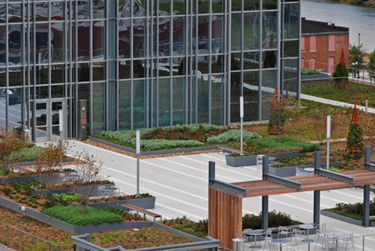
    The Pinnacle at Symphony Place, a 29-story office building in downtown Nashville, opened this month. The building includes 520,000sf of Class A office space. It is home to law offices of Bass Berry and Simms and the headquarters of Pinnacle Financial Partners. The building designed by the award winning architectural firm Pickard Chilton with Nashville architects EOA Architects is anticipated to receive LEED-Silver certification from the United States Green Building Council (USGBC). With the inclusion of a 28,000sf rooftop garden, the building contributes significantly to Nashville’s ever growing green infrastructure

    The green roof, designed by our office, is located on the 7th floor above the parking garage and includes a series of spaces that can be enjoyed by the building’s tenants. The area is comprised of 9,400sf of pedestal pavers and 19,000sf of vegetated areas. One hundred percent (100%) of the pavers were selected to exceed the minimum solar reflectance standards established by the LEED rating system. The striping pattern continues the prominent vertical fins on the facade of the building into the rooftop garden area. The planting areas are a combination of extensive green roof (planting media depths ranging between 5-9”) and semi-intensive areas (planting media depths ranging between 18”-30”). The semi-intensive areas were planted to reflect a more traditional landscape around each of the gathering areas and provide areas for trees to shade and scale the spaces. In an effort to establish a more pedestrian scaled environment and additional interest a series of 12ft pyramidal trellis structures were incorporated in the extensive green roof areas.

    It is estimated that the green roof can retain nearly 67% of the annual rainfall falling directly on it. In addition, it reduces the peak flows, is significantly cooler than neighboring conventional roofs, reduces thermal heat gains in the water that enters the stormwater system, and provides a beautiful space to look upon and enjoy.

    We are honored to have been a part of such an exciting project and look forward to watching it grow. We have been pleasantly surprised by the significant growth the plant material has shown in a short time period. As it matures, we will keep you up to date on its progress.

    -Brian Phelps


    Portland’s Green Streets

    25 11 2009

    Streetsblog San Francisco had a great post last week that reported on a recent tour of Portland’s Green Streets taken during the Congress for the New Urbanism’s Project for Transportation Reform Conference. The post includes a number of wonderful green street examples. The quality of the installations are impressive. A representative of Portland’s Bureau of Environmental Services (BES) was quoted as saying the green streets were necessitated as a result of the City’s need to comply with a Clean Water Act lawsuit. The cost of conventional stormwater infrastructure topped nearly $150 million. This cost encouraged the city to explore alternatives like green streets for reducing water volumes. David Elkin,the BES representative quoted in the post, estimates the solution saved the City $60 million dollars in stormwater pipe replacement. The post is worth checking out.

    -Brian Phelps


    Opportunity Delayed?

    23 11 2009

    Over the past decade, cities have utilized a variety of methods to encourage and/or require sustainable building practices within their jurisdictions. All across the country green building incentives were enacted. According to a recent AIA Survey, 138 cities have some form of green building programs. Methods that rely on density bonuses or tax increment financing to reward/incentivize developers were predicated on growth. Unfortunately, the building boom over the last three to five years has fizzled (for the time being at least). It is no secret the development landscape has changed. Obviously, fewer projects being built equals less opportunities to incorporate green infrastructure within our landscapes. This really isn’t a problem if a project was being built in a greenfield. In fact, on a number levels especially in regards to stormwater management and water quality, it is preferable. But for the greyfields and brownfield sites that comprise much of our urban landscape, it is opportunity delayed. The opportunity being to convert these sites to better use and mitigate their negative impact. The old parking lots and retail centers continue to absorb and radiate heat while directing polluted stormwater into overburdened infrastructure and streams. This is particularly acute in areas that were built prior to modern stormwater standards.

    So what are cities doing to encourage the incorporation of green infrastructure under these new market realities?

    Stormwater Fees. Realizing that general funds can no longer meet the demands imposed on cities by the Federal Government and State Agencies, many cities have or are relying heavily on stormwater fees. Typically these fees are applied to everyone’s property based on impervious surfaces. It is common under these programs for property owners to receive discounts through the use of various stormwater management strategies. These often include green infrastructure related tools (i.e. green roofs, bioretention areas, pervious pavements). Depending on the significance of the fees, this can be a deciding factor for property owners to retrofit their properties. However, in most cases they are not high enough to warrant major investments.

    Dedicated Funding. The City of Portland has taken a page from the art world and have enacted a “One Percent for Green” program that works similar to the more common “Percent for Art” programs. It is funded by allocating one percent of the city’s construction budget for the purpose of building green streets both on public and private property as long as it treats public stormwater. It also includes any new and retrofit projects that wouldn’t trigger the Stormwater Management Manual.

    Economy of Scale. The unique double functioning nature and triple bottom line benefits of green infrastructure has prompted cities to combine stormwater management with other projects such as parks, streetscapes, road improvements, and other capital projects. The economy of scale allows them to stretch their dollars further to meet the needs of the city.

    Direct Reimbursement. As mentioned in an earlier post about Chicago’s green roof program, cities are offering direct reimbursement of installing green infrastructure. This has manifested itself mainly for constructing green roofs. These reimbursements typically run around $5 per sf. Depending on the situation this can reduce the square foot cost for a green roof by as much as 30%.

    Clean Water State Revolving Fund (CWSRF). CWSR Funds are another useful tool offered by each individual state that municipalities are utilizing to fund green infrastructure projects. Funding is provided by a combination of EPA grants and State matching funds. The basic premise is the fund provides low interest loans to municipalities for wastewater treatment, stormwater management, nonpoint source abatement and estuary protection projects. The payments toward the loan are reincorporated back into the fund where they can be loaned again. This method is increasingly becoming popular as a means of implementing green infrastructure projects across the country. The 2009 Stimulus Plan (American Recovery and Reinvestment Act, ARRA) gave a considerable boost to these programs. It includes $4 billion for Clean Water State Revolving Fund projects and $2 billion for Drinking Water State Revolving Fund projects.

    Together programs like these have enabled municipalities to continue investment in their stormwater infrastructure. As cities grapple with the current market conditions, we should expect to see new creative funding ideas and a continued commitment toward increasing the use of green infrastructure throughout our cities.

    -Brian Phelps


    Hill Center Green Hills receives Middle Tennessee ASLA Honor Award

    20 11 2009

    Streetscape

    Underground Rainwater Harvesting Tanks

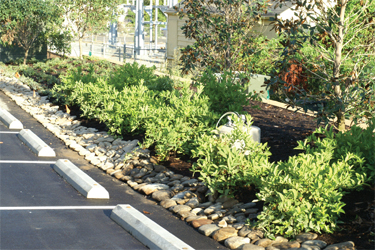
    No Curbs with Filter Strips

    The Middle Tennessee Chapter of the American Society of Landscape Architecture recently presented Hawkins Partners, Inc. a 2009 Honor Award in the environmental/urban design category for its work on the Hill Center in Green Hills.

    Hollie Cummings, executive director of ASLA Tennessee Chapter, was quoted in an article in the Tennessean (Hill Center wins architecture award for urban design) saying, “The jury appreciated the use of details that served to unify the development and resulted in a cohesive design solution.”

    HPI was involved in the planning, design, and construction of this infill redevelopment project located in Green Hills. The 220,000 s.f. mixed-use development consists of retail, restaurant, and office space. Site design elements include a pedestrian activated streetscape, which consists of wide sidewalks for shoppers, places for people to sit and relax or visit with friends, and outdoor dining along a tree-lined boulevard.

    Sustainability played a big role in the design process. HPI collaborated with the design team to provide 100% improvement in the stormwater treatment over the previous site conditions. The site captures rainwater in a 25,000 gallon underground tank for use in irrigating the landscape (comprised primarily of native plants), and also utilizes new bioretention areas, which slow and reduce runoff – ultimately helping lower the temperature of runoff into the nearby Sugartree Creek. Some other items include a white roof on the Whole Foods store, over 60% of the parking is provided by covered structures and all the site lighting utilizes cut-off luminaires to reduce light pollution.

    This project also won the Excellence in Development Award presented by Urban Land Institute (ULI).

    – Kelly Copeland


    Triple Bottom Line of Green Infrastructure

    18 11 2009

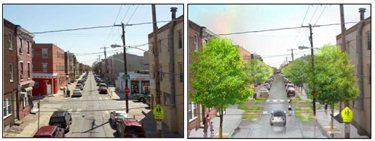
    Before and After of Green Infrastructure Improvements
    (Source:“Green Cities Clean Waters” Plan)

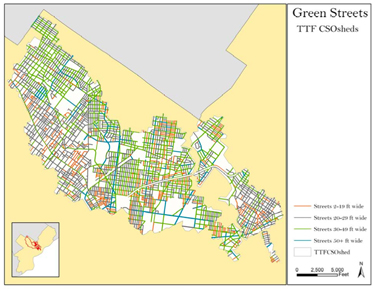
    In an earlier post titled “Making Green Infrastructure Common Place” we discussed the recent release of Philadelphia’s $1.6 billion dollar “Green Cities Clean Waters” Plan. Its thrust is to transform over 4,000 acres of impervious areas within the City’s Combined Sewer System to green space over the next 20 years through the use of green infrastructure strategies. This would involve converting over 34% of all existing impervious areas. Of this, the conversion will primarily be made on public property and right-of-ways. Green streets, the most widely used management tool, will comprise nearly 38% of these improvements (see graphic). The report claims this is “the largest green stormwater infrastructure program ever envisioned in this country”. While green infrastructure has been utilized and proven in many parts of the country, the sheer magnitude and commitment of the city is a radical departure from the conventional approach to stormwater management practices.

    Map of Green Street Locations
    (Source:“Green Cities Clean Waters” Plan)

    So why did Philadelphia decide to rely so heavily on green infrastructure as a means of reducing overflows in their CSO system? Quite simply it was cheaper, significantly cheaper. The plan estimates over the next 20 years the plan is to be implemented, the “triple bottom line” benefits (social, environments, economic) of the plan alone will add up to a present value of $2.2 billion dollars. The following is a breakdown of the benefits that comprise this figure.

    • Heat Stress Mortality Reduction (35%)
    • Recreation (22%)
    • Property Value Added (18%)
    • Water Quality and Habitat (14.5%)
    • Air Quality (4.6%)
    • Avoided Social Costs from Green Jobs (3.7%)
    • Energy Savings (1.0%)
    • Carbon Footprint Reduction (0.6%)
    • Reduction in Construction- Related Disruptions (0.2%)

    So instead of employing conventional underground infrastructure that is one-dimensional, and is estimated to cost $16 billion, the city has decided that implementing a multi-dimensional strategy with multiple benefits made more sense. But not only is it more desirable, it is politically easier to implement because it makes the city a more beautiful and healthy place. So if you are going to have to spend the money anyway, why not make it count.

    The shortcomings of the conventional “tanks and tunnels” approach were not only that it exceeded the EPA’s affordability standard for stormwater management (2% of median household income), but it also did not address water quality issues and could require green infrastructure tools anyway to meet these requirements. In addition, the report points out that the conventional solution isn’t aligned with the EPA’s broader goals of sustainability, reduces streams baseflow thereby damaging the resources that is designed to protect, and doesn’t offer any secondary triple bottom line benefits. Furthermore, since the conventional solution is not delivered incrementally it is not flexible and does not offer any benefits immediately.

    Green infrastructure on the other hand offered the city the opportunity to revitalize and restore the city’s streams and rivers, enhance the quality of the built environment throughout the city, improve air quality, reduce the heat island effect, and sequester carbon. While accumulating these benefits, the approach was more flexible, offered immediate benefits, and, most importantly, the cost of implementation was offset by the dollar value of the benefits. (see Volume 2: Triple Bottom Line Analysis of the plan for specifics)

    While conventional infrastructure has its place, the combination of the two can play a significant role in addressing many of the issues facing our cities. It is critical that we continue to move toward making these strategies common place. By doing so we can make our cities healthier and more beautiful for all of us to enjoy, while at the same time responsibly managing our stormwater.

    -Brian Phelps


    The Sustainable by Design Challenge

    16 11 2009

    A recent article by Ajay Garde has been published in the October 2009 issue of the Journal of the American Planning Association). The article describes a study and analysis of projects that applied for 2007 LEED-ND pilot program certification. LEED-ND is a rating system written collaboratively by the U.S. Green Building Council (USGBC), the Congress for the New Urbanism (CNU), and the Natural Resources Defense Council (NRDC) to promote sustainable development patterns and practices. The following is an excerpt from a JAPA press release:

    According to author Ajay Garde, the LEED-ND committee has taken “the technical credentials of LEED and the criteria of New Urbanism for neighborhood design and created LEED-ND.” This approach may undermine the use of green criteria, as developers may focus on New Urbanist criteria instead. These drawbacks mean that LEED-ND is suitable as a supplement to, but not as a replacement for, local planning for sustainability that considers projects on a case-by-case basis within the local context.

    My interpretation of Mr. Garde’s article is that LEED-ND is a great start, but it may not be the only answer to ensuring the absolute best development practices. Likewise, typical Best Management Practices (BMPs) for stormwater quality alone within a sprawl setting do not necessarily equal the best solution for a sustainable future…but they too are a good start.

    One of the conclusions in the study suggests that LEED-ND certification is weighted more heavily for projects based on their location, layout and density with less emphasis on green infrastructure and technology. Mr. Garde suggests “that more points should be awarded for criteria such as solar orientation, onsite renewable energy sources, and other criteria from the green construction and technology category that contribute to energy and water efficiency.” I agree. Couldn’t we have well designed projects in appropriate locations that incorporate green infrastructure and technology?

    Often in the real estate business, developers will look for the proverbial low-hanging fruit. If a developer can attain LEED-ND certification by Smart Location & Linkage and Neighborhood Pattern & Design with minimal emphasis on Green Infrastructure & Building, it’s probably safe to assume many will choose that route. Development costs vs. value and profit (short term vs. long term) are considered. Government regulations and entitlements are also a part of the equation.

    LEED-ND is a voluntary and market-driven rating system. If a developer has a choice of developing in an urban area with more regulations but the incentive (faster approval times, increased density, etc.) of attaining LEED-ND certification or higher vs. developing in a suburban area with less regulation, which will they choose? This will continue to play out as the economy recovers.

    How do government officials and agencies, planners and non-profits create either market-driven incentives, government regulations or a combination of both to ensure future development is as sustainable as possible in terms of social aspects, economics, and the balance between natural and man-made environments?

    These are the questions and this is the challenge moving forward, but it’s comforting to know that progress is being made every day.

    -Brian Hudson


    EPA to test porous pavement and raingarden benefits

    11 11 2009

    1700 Charlotte
    1700 Charlotte in Nashville
    Combines Porous Concrete & Bioswales

    Traditional asphalt parking lots may seem to be the most cost efficient, but underlying costs such as increased pollution and water load on our sewer systems need to be considered as well. In an attempt to measure those underlying costs the EPA has replaced nearly 43,000 SF of their traditional asphalt parking with 3 different types of permeable pavement systems and several raingardens with different planted vegetation. At their Edison, NJ facility they will conduct a decade long study to evaluate and document the performances of these permeable systems on the basis of removing pollutants and filtering capabilities. Having these systems all in the same location will likely result in more balanced testing of each material.

    This study comes at an ideal time as many cities are beginning to re-evaluate old paving methods in order to reduce the load on existing sewer systems or just to reduce the amount of toxin runoff from paved surfaces to our nearby rivers and lakes. Traditional asphalt parking lots collect oil, grease and other debris over time, after a heavy rain or snowstorm these toxins are washed from the parking surface to the nearest storm drain or permeable surface. Replacing this impervious surface with a permeable pavement or raingarden will allow plants and soils to naturally filter the pollutants, while re-charging the ground water table.

    Porous for Blog
    Porous Concrete

    -Will Marth


    Opportunities

    9 11 2009

    Are words necessary?

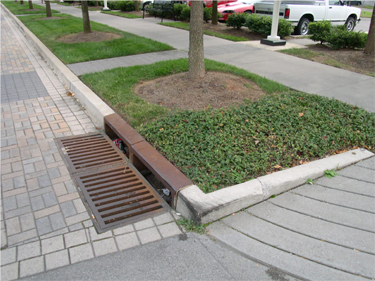
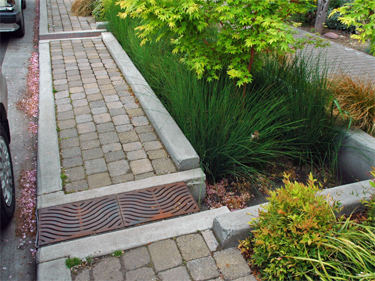
    curb and gutter

    green street